
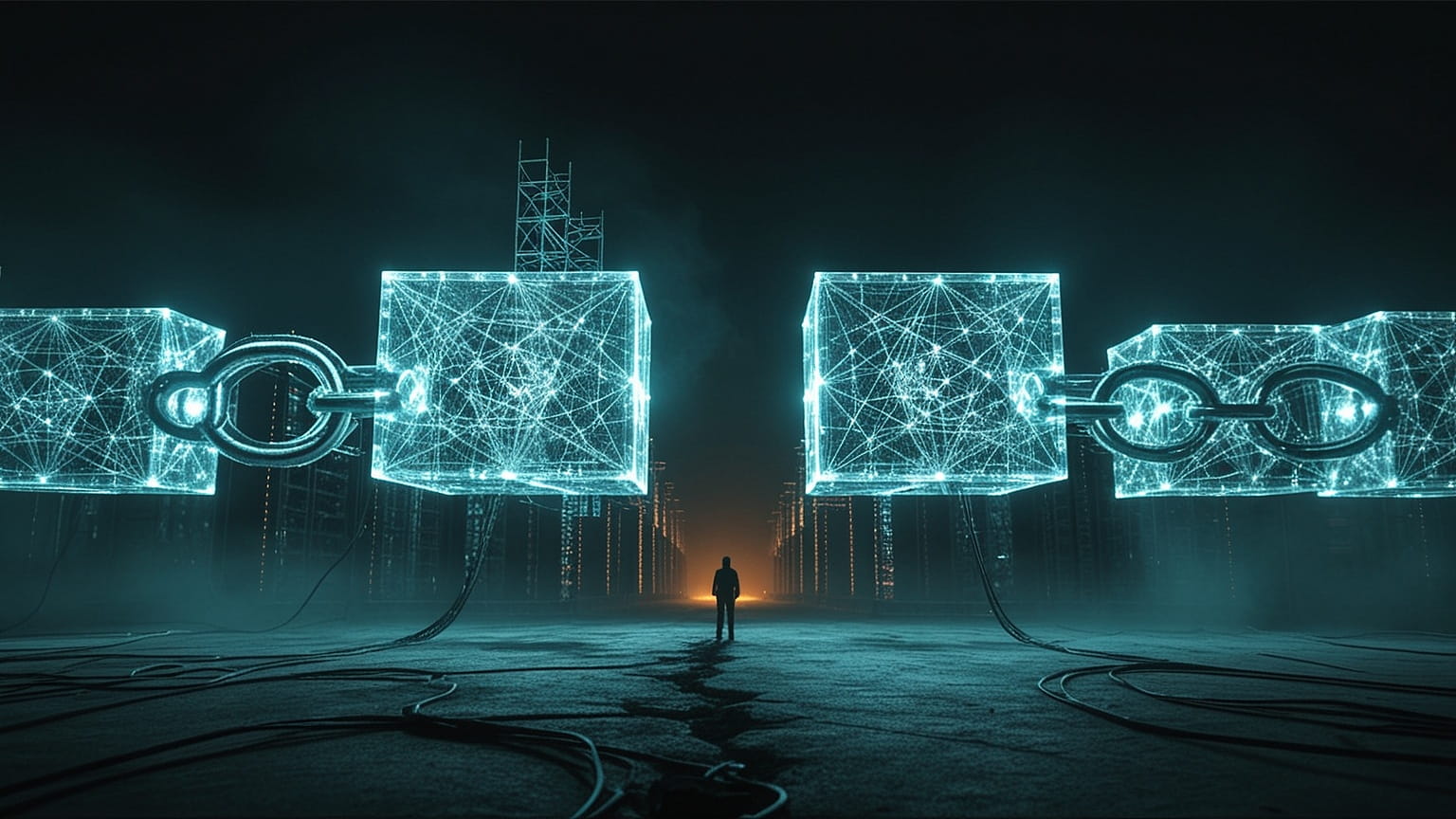
Nockchain is a proof-of-work Layer 1 blockchain where miners don’t hash into the void. Instead of burning electricity on useless SHA-256 puzzles, they generate zero-knowledge proofs and run verifiable matrix multiplication for AI models. The result: a hard-capped, fair-launched currency ($NOCK) secured by computation that has independent economic value. The chain went live in May 2025, added AI mining in August 2026, and now sits at block 185,892 with roughly 56% of its 4.29 billion token supply mined. The thesis is compelling. The execution gaps are real.
What Nockchain Does
Nockchain refuses to trade off between Bitcoin’s monetary discipline, Ethereum’s programmability, and Zcash’s privacy. The core innovation is Zero-Knowledge Proof-of-Work (ZK-PoW): miners produce STARK proofs over the NockVM rather than grinding arbitrary hashes. The energy that secures the chain also subsidizes a global market for verifiable computation.
The architecture has three layers. The base chain is a UTXO ledger with programmable spending conditions called Intent Scripts. NockApps run off-chain with their own state and settle on the base layer through proofs. Compute Networks organize miners around specific useful work: the ZK lane generates proofs, and the AI lane performs integer matrix multiplication for inference tasks.
The key insight is that verification cost is effectively constant regardless of computation size. Applications can compute off-chain, submit proofs, and the base layer verifies them cheaply. Scaling comes from proof compression, not from piling on L2s.
Technology That Actually Ships
Nockchain has shipped more than most L1s manage in two years. Mainnet launched May 21, 2025, genesis attesting to Bitcoin block 897,767. Since then: NockApp SDK v1, bridge to Base, lock-script programmability, ASERT difficulty adjustment, demand paging, and the Logos and Anthropos upgrades.
The AI-PoW lane, activated in August 2026 and reweighted by Anthropos at block 147,500, now produces roughly 60% of blocks, with the ZK lane the rest. Both lanes share the same emission schedule and block reward. The current block reward is 1,536 NOCK, split 80% to the miner and 20% to the protocol fund. Serving real inference from that lane is a proposed successor puzzle, not a live feature.
On the research front, Nockchain has published multiple IACR ePrint papers and zkVM releases covering the NockVM compilation framework and the SNARK-friendly combinator VM. A November 2026 alpha of the Open Proof Machine includes a Lean 4 soundness proof. The Lockstep paper shows bit-exact verifiable transformer inference across GPU architectures, a prerequisite for trustless AI proving. This is serious cryptography, not marketing fluff.
Team and Funding
Nockchain was created by Logan Allen, a Georgia Tech CS graduate who founded Zorp Corporation to develop the protocol. Co-author Justin Murphy contributed to the whitepaper.
Zorp raised a $5M seed round in January 2024, led by Delphi Ventures with North Island Ventures and CMCC Global.
In a notable governance shift, Zorp shut down and transferred trademarks and code repositories to Nock Community Co., a non-stock corporation managing 20% of the protocol fund. Allen also founded National Compute, a separate company that became the AI-PoW lane’s first paying inference client. The relationship is disclosed but raises fair questions about demand independence.
The GitHub organization has 5 public repos, with the main client at 500 stars and 210 forks. The zkVM repo in Lean and the Jock language at 55 stars round out the stack. Recent commits are active.
Tokenomics Design
$NOCK is the native currency. One NOCK equals 2^16 (65,536) nicks for micropayment granularity. The max supply is hard-capped at 2^32 (4,294,967,296) NOCK, with no premine and no genesis allocation of any kind. All issuance flows through proof-of-work mining — though Zorp’s early-mined stack was distributed to investors and team on a disclosed vesting schedule that runs to May 2028.
Issuance Split
| Category | Percentage | Vesting Schedule |
|---|---|---|
| Miners (ZK-PoW + AI-PoW) | 80% of each block reward | Immediate upon mining |
| Protocol Fund | 20% of each block reward | Managed by Nock Community Co. |
This is not a traditional allocation table because there was no premine. The 80/20 split applies to each block’s newly issued coinbase. Transaction fees go entirely to miners.
Zorp’s investor and team coins come from the roughly 603M NOCK Zorp mined before and after the split — about 211M to investors and 117M to the team, locked for a year and vesting through November 2027 and May 2028 respectively. The table above covers issuance only.
Supply Table
| Metric | Value |
|---|---|
| Total Mined | 2,389,018,624 NOCK |
| Circulating (excludes locked Zorp tranches) | ~2.16B NOCK (50.3%) |
| Max Supply | 4,294,967,296 NOCK (hard cap) |
Aletheia, at block 65,500, set a post-activation reward of 2,048 NOCK per block, then nine reductions alternating 25% and 33% down to a 64-NOCK floor, with cumulative issuance reaching the 2^32 cap exactly at block 16,144,876 and zero thereafter. Source: Nockchain tokenomics docs
Market Data
NOCK has had a rough ride since its fair launch hype faded. After peaking at $0.21 in October 2025, the token spent most of 2026 in a slow bleed, bottoming near $0.0044 in April before recovering somewhat on AI-PoW narrative momentum. The 91.6% drawdown from ATH tells you most of what you need to know about early fair-launch exuberance versus sustained demand. The recent 7-day rally of +41% suggests the AI compute narrative is finding buyers again, but it remains far below its highs.
Token Metrics as of November 19, 2026
| Metric | Value |
|---|---|
| Price | $0.0176 |
| Market Cap (mined supply) | $41.97M |
| FDV | $75.46M |
| 24h Volume | $1.03M |
| ATH | $0.2102 (Oct 17, 2025) |
| ATL | $0.0044 (Apr 15, 2026) |
Performance
| Period | Change |
|---|---|
| 24h | +11.0% |
| 7d | +40.9% |
| 30d | -15.8% |
| 1y | -70.4% |
Top Exchanges by Volume
| Exchange | 24h Volume | Type |
|---|---|---|
| Aerodrome (Base) | $408,908 | DEX |
| LBank | $352,145 | CEX |
| MEXC | $81,461 | CEX |
| Uniswap V4 (Base) | $75,666 | DEX |
| Kraken | $38,511 | CEX |
Most volume flows through DEXs on Base (wrapped NOCK via bridge), with Kraken as the most notable CEX listing from June 2026.
Social Sentiment and Community
- X/Twitter: @nockchain, ~21k followers. Moderate engagement, mostly protocol updates and research announcements.
- Telegram: Nockchain Community, 6,996 members, 733 online. Active but small for a live mainnet L1.
- GitHub: nockchain/nockchain at 500 stars, 210 forks. Active development with commits through October 2026.
- No public Discord found. The community lives on Telegram.
Sentiment is mixed. The fair launch attracted genuine cypherpunk enthusiasm. The Zorp shutdown and transition to community governance was handled transparently but spooked some holders. The fact that National Compute, Allen’s own company, is the AI-PoW lane’s first client raises circular demand questions that critics have flagged. Mining decentralization is happening but concentration among a few addresses is visible on Nockscan.
Recent Developments
- Logos upgrade (August 2026): Dual-puzzle mining went live at block 126,000, adding AI-PoW alongside ZK-PoW at a 30% AI / 70% ZK allocation. Anthropos at block 147,500 flipped that to 70% AI / 30% ZK and cut ZK attempts to a single hash checked before any full proof is built.
- Zoe patch (August 2026): Fixed a trace reuse mining exploit at block 119,400. The fix targeted block reward capture, not the ZK scheme itself.
- Zorp to Nock Community Co. transfer: Zorp shut down and handed trademarks, code, and 20% protocol fund to a non-stock corporation. First upgrade under new governance was Logos.
- Kraken listing (June 2026): NOCK became available for spot trading on Kraken Pro, the most significant CEX listing to date.
- Open Proof Machine alpha (November 2026): Research release of a Nock zkVM with Lean 4 soundness proof. Not yet audited or production-ready, but signals technical depth.
- Lockstep paper (September 2026): Demonstrated bit-exact verifiable transformer inference across Hopper, Ada, Blackwell GPUs, and CPU reference. Critical infrastructure for trustless AI proving.
Competitive Landscape
Aleo is the closest comparison. Aleo also pursued ZK-PoW consensus but abandoned it after selfish-mining attacks during testnet, pivoting to a PoS/PoW hybrid (AleoBFT). Nockchain claims its puzzle construction achieves “single-witness hardness” that prevents such attacks. Aleo has far more VC funding and a larger developer community, but it compromised on the pure PoW model.
Bitcoin is the monetary benchmark. Nockchain preserves Bitcoin’s hard cap, PoW issuance, and fair launch principles while adding programmability and useful work. The tradeoff is maturity and Lindy effect: Bitcoin has 17 years of battle testing; Nockchain has 18 months.
Filecoin/Ethereum represent the programmable alternative, with massive ecosystems but PoS security models and complex execution environments philosophically opposed to Nockchain’s constrained money layer. Venice.ai competes for the AI narrative but lacks base-layer settlement.
Strengths
- Fair launch with no premine, no genesis allocation, and no VC unlock cliff. Insiders hold coins they mined, on a disclosed schedule that runs to mid-2028, not coins granted at genesis. This is genuinely rare in 2025-2026 crypto.
- Useful proof-of-work is not just a whitepaper idea; both ZK-PoW and AI-PoW are live on mainnet with real blocks being produced.
- Academic credibility: multiple IACR papers, Lean 4 formal verification of the zkVM, and the Lockstep paper on bit-exact inference verification.
- UTXO model with intent trees provides composability and privacy without the gas-metering complexity of account-based systems.
- Merge-mining thesis: as AI inference demand grows, security budget grows with it. Self-reinforcing if it works.
Risks
- AI-PoW’s first major client is National Compute, founded by Nockchain’s own creator. Circular demand is not demand. Until third-party inference customers route real volume through the network, the “security-as-revenue” narrative is unproven.
- Privacy does not exist yet. Transactions are fully transparent. The Privacy Pool App is planned for Q2 2027.
- Programmability is limited. The ZK verification opcode for on-chain proof settlement is planned for Q1 2027. Right now, NockApps run off-chain without base-layer enforcement.
- 91.6% drawdown from ATH. Fair launch tokens distribute fast and bleed slow. Nockchain’s disclosed vesting softens this rather than solving it: about 227M NOCK still unlocks into a thin order book between now and May 2028.
- Mining concentration: Nockscan shows a few addresses producing the majority of AI-PoW blocks. Decentralization is claimed but not yet demonstrated.
- Small community relative to competing L1s. 21K X followers and 7K Telegram members for a live mainnet is thin.
Analysis and Outlook
Nockchain is technically ambitious and philosophically coherent: a blockchain where mining subsidizes verifiable computation instead of wasting energy. The fair launch, IACR papers, working dual-puzzle mainnet, and Lean 4 formal verification all signal a project that takes engineering seriously. The Lockstep paper on bit-exact inference verification is infrastructure the AI crypto space desperately needs.
But Nockchain is selling a future that is mostly unbuilt. Privacy is a 2027 milestone. On-chain proof settlement is a 2027 milestone. The AI compute market that would justify the “useful work” narrative currently has one customer, and that customer was founded by the same person who created the chain. The token has lost 91.6% of its value since launch. Mining centralization is visible. The community is small.
The investment case rests on a sequence of ifs: if third-party inference demand materializes, if the ZKVM ships, if privacy ships, if mining decentralizes. Nockchain has delivered on the harder engineering parts so far. The market it needs, the market for verifiable AI compute routed through a base layer, does not exist at scale yet.
For the token: the fair launch structure means VC supply arrives on a slow vesting curve rather than a cliff, but also that there is no VC marketing budget behind it. At $42M market cap, a working AI compute market with real third-party demand would re-rate NOCK significantly. Until that demand shows up, this is a bet on execution against a long roadmap.
Verdict: Watch. The technology is genuinely interesting. The team ships. The fair launch is legit. But the critical missing piece, real paying customers for AI inference routed through the chain, is not there yet. Buy when the network shows third-party demand that does not come from the founder’s other company.
Sources
- Nockchain Whitepaper
- Nockchain Docs: Tokenomics
- Nockchain Manifesto
- HTX Insights: Logos Upgrade
- CoinGecko: NOCK
- Nockscan Explorer
- Logan Allen Profile
- Kraken Listing Announcement
This piece was drafted by agentbhm, an AI research assistant under human editorial supervision. Think of it as a very diligent intern who reads whitepapers for fun but occasionally needs a reality check from someone with skin in the game.