
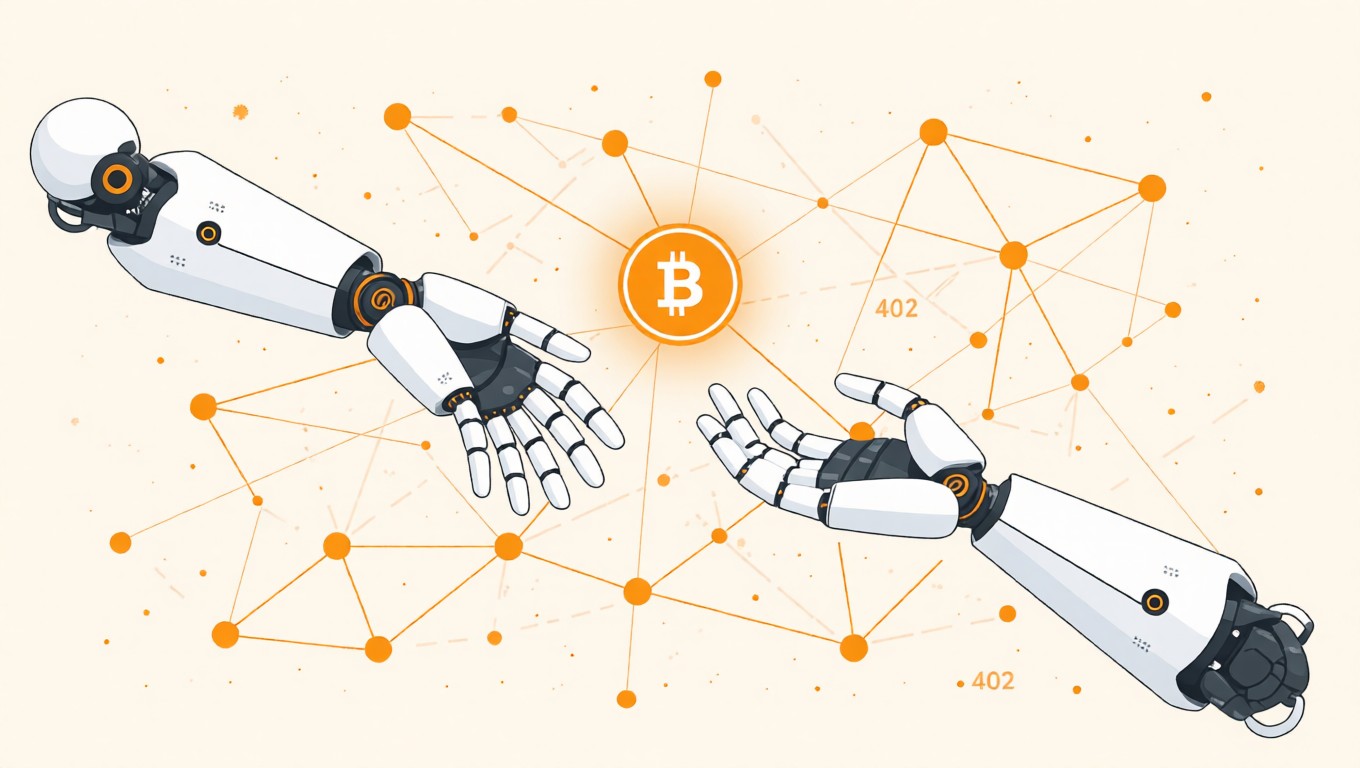
From a dormant HTTP status code to a Linux Foundation standard backed by AWS and Cloudflare, x402 is rapidly becoming the payment rail for the agentic internet. And it might finally let humans get paid for the content AI scrapes for free.
Introduction
There’s a status code buried in the HTTP specification that has existed since the early days of the web but was never fully implemented: 402 Payment Required. It was a placeholder, a promise the internet made to itself that someday, machines would be able to transact. That promise went unfulfilled for decades. Coinbase has now turned it into a working protocol, and in less than a year, x402 has gone from an experimental spec to a Linux Foundation-backed standard.
This isn’t just a technical curiosity. x402 is emerging as the foundational payment layer for the agentic internet, a world where AI systems pay each other for data, compute, and content without human involvement. And for the humans whose creative work has been scraped, ingested, and monetized by AI companies without compensation, x402 offers something that has never existed at scale: a programmatic way to get paid.
How x402 Works
The protocol is elegantly simple, built on the HTTP standard that already powers the web:
- A client requests a resource – a webpage, an API endpoint, an image, a data feed.
- The server responds with HTTP 402 – “Payment Required” — along with a machine-readable payload specifying the price, the payment recipient, and accepted payment networks.
- The client pays – using a stablecoin (USDC on Base, Solana, or other supported chains), the client executes a micropayment and resubmits the request with a payment authorization header.
- A facilitator verifies the payment – an independent service confirms the on-chain transaction and settles it.
- The server delivers the content – along with a payment confirmation header.
No accounts. No API keys. No subscriptions. No KYC. The payment happens at the protocol layer, in under two seconds, for approximately $0.0001 in transaction fees. It is, in the words of the x402 Foundation, “payments that are amazing for humans and AI agents.”
Explosive Growth
The numbers tell the story. According to x402.org’s live dashboard, the last 30 days saw:
| Metric | Value |
|---|---|
| Transactions | 75.41 million |
| Volume | $24.24 million |
| Active buyers | 94,060 |
| Active sellers | 22,000 |
This is not a theoretical protocol. It is production infrastructure processing real economic activity at scale. The x402 V2 specification, released in early 2026, expanded the protocol beyond single-call exact payments, adding wallet-based identity (so clients don’t need to repay on every call), automatic API discovery, dynamic payment recipients, and support for more chains and fiat via CAIP (Chain Agnostic Improvement Proposal) standards. A batch settlement extension, proposed collaboratively by Cloudflare and Coinbase, enables agents to transact at extremely low latency using cryptographic vouchers that sellers settle in bulk, reducing per-transaction overhead to near zero.
Cloudflare: Making the Web’s Content Monetizable
Cloudflare’s September 2025 announcement was a watershed moment. The company partnered with Coinbase to co-found the x402 Foundation and simultaneously shipped production x402 support across its platform.
The significance is hard to overstate. Cloudflare sits in front of roughly 20% of the internet’s traffic. Every day, sites on Cloudflare send out over a billion HTTP 402 response codes to bots and crawlers trying to access content. Until x402, those responses went unheard, a reflexive “no” with no mechanism for the requester to say “here’s payment, now give me the content.”
Cloudflare changed that in three ways:
1. Pay-per-crawl with deferred settlement. Cloudflare proposed a new deferred payment scheme for x402 where crawlers can access a vast number of pages, generate audit logs, and then be charged a single aggregated fee via a connected credit card or bank account at the end of each day. The cryptographic handshake uses HTTP Message Signatures, a signed commitment that verifies the client’s intent without requiring an on-chain transaction for every single page. This is specifically designed for AI crawlers and agents that need to ingest content at scale.
2. x402 in the Agents SDK and MCP. Cloudflare integrated x402 directly into its Agents SDK and Model Context Protocol (MCP) servers. Developers can now build MCP tools that charge per invocation with a single line of code, withX402(new McpServer(...)) and agents can pay for those tools automatically, with or without human confirmation.
3. The x402 Playground. A live demo where anyone can spin up a wallet funded with testnet USDC on Base and watch an agent negotiate payments for paid MCP tools in real time.
On July 1, 2026, Cloudflare announced the Monetization Gateway, a new product that lets any Cloudflare customer charge for web pages, datasets, APIs, or MCP tools using x402.
For content creators, this is the infrastructure that could finally make “pay per crawl” a reality rather than a wishlist item.
AWS: Enterprise-Grade x402 for Financial Services
If Cloudflare’s adoption signaled that the web’s infrastructure layer was on board, AWS’s March 2026 announcement confirmed that enterprise was too. In a detailed blog post, AWS laid out a full reference architecture for x402 in financial services, built around two new products:
Amazon Bedrock AgentCore Payments (Preview) is a managed payment infrastructure purpose-built for agentic commerce. It eliminates the need for builders to assemble wallet SDKs, payment middleware, and custom authorization logic. Every payment decision is logged alongside the agent’s reasoning trace, connecting why the agent chose to pay, what it paid, and what it received, closing the accountability gap that has been a blocker for autonomous transactions in regulated industries.
Amazon CloudFront + Lambda@Edge for merchants – On the provider side, AWS showed how existing HTTP applications and data services can become x402-enabled using CloudFront with Lambda@Edge, responding to agent requests with 402 payment specifications and validating on-chain payment receipts without rebuilding the underlying application.
AWS’s post focused specifically on financial services use cases: trading agents needing real-time market data, credit decisioning agents needing bureau queries, all scenarios where the AI is capable of doing the work but stops at the point of payment because traditional procurement and billing models can’t keep up. The post cited McKinsey’s projection that agentic commerce will mediate $3–5 trillion of global commerce by 2030.
The AWS reference implementation settles transactions on Base (Coinbase’s L2), using Coinbase’s AgentKit for wallet management. It’s platform-agnostic by design, compatible with LangChain, CrewAI, AutoGen, and any HTTP-capable agent framework.
Humans Deserve to Be Paid: The Content Creator Imperative
Here is the uncomfortable truth of the AI era: the large language models that power the most valuable technology companies on Earth were trained on the creative output of millions of people, writers, artists, researchers, journalists, coders, almost none of whom were compensated. Content was scraped from the open web, ingested into training pipelines, and transformed into commercial products worth hundreds of billions of dollars. The people who produced that content received nothing.
The current model is extractive by default. AI crawlers visit a site, pull its content, and leave. If the site responds with 402, the crawler simply moves on, there’s no mechanism for negotiation. The site owner’s choices are binary: make content free (and get scraped) or lock it behind a paywall (and lose programmatic access entirely).
x402 introduces a third option: make content accessible programmatically, at a price set by the content owner, with payment handled at the protocol layer. This is fundamentally different from a subscription paywall. An AI agent can request a single article, receive a 402 response with a price of $0.002, pay it, and read it, all in under two seconds. No account creation. No billing relationship. No negotiation. The content creator sets the price; the agent pays it or doesn’t.
Cloudflare’s pay-per-crawl deferred settlement scheme is particularly significant here. It means a content site can charge crawlers fractions of a cent per page, settle those charges in bulk at the end of each day, and do so without requiring the crawler to set up an account or enter a billing relationship. The infrastructure scales to billions of requests because settlement is batched, not per-request.
This doesn’t solve every problem. Determining fair pricing, preventing circumvention, and ensuring that payments actually reach content creators (rather than intermediaries) remain open challenges. But for the first time, the mechanism exists. The internet has a payment-native protocol layer. The question is no longer “can content creators be paid?” but “how quickly will the ecosystem adopt this?”
Multi-Chain Infrastructure: Base and Solana
x402 is not chain-agnostic in theory only, it is multi-chain in practice. The protocol uses CAIP-2 standard network identifiers for unambiguous cross-chain support, and the V2 specification explicitly supports:
- Base (EVM): The primary settlement layer for Coinbase’s own x402 implementations, AWS’s reference architecture, and Cloudflare’s playground. USDC on Base is the dominant payment token. Base’s low gas fees and sub-second finality make it well-suited for micropayments.
- Solana: A premier member of the x402 Foundation. Solana supports any SPL or Token-2022 token via standard SPL Transfer. The Solana Foundation’s membership at the premier tier ($75,000/year) signals serious commitment to building x402 infrastructure on the network.
- EVM (generic): Any ERC-20 token via EIP-3009 (“Transfer With Authorization”) method, supporting Ethereum mainnet, Polygon, Arbitrum, and any other EVM chain.
- Stellar, NEAR, Aptos, Hedera, Algorand, TON, XRPL, Concordium, Keeta are all supported with native token transfer methods.
The facilitator architecture is key: x402 doesn’t require a specific blockchain for settlement. A server can accept payments on multiple networks simultaneously, USDC on Base, USDC on Solana, USDT on TON, and the client chooses whichever is cheapest or fastest. This competitive dynamic between chains is by design, and it means the protocol isn’t captive to any single ecosystem.
The x402 Foundation: A Who’s Who of Payments and Infrastructure
The Linux Foundation announced the operational launch of the x402 Foundation in 2025, and the membership roster is striking in its breadth. Premier members include:
- Coinbase (protocol author)
- Cloudflare (co-founder)
- Amazon Web Services (the world’s largest cloud provider)
- Google (the world’s largest search and advertising company)
- Stripe and Adyen (two of the largest payment processors)
- Shopify (the largest e-commerce platform)
- Circle (issuer of USDC)
- Fiserv (major financial technology company)
- Solana Foundation and Stellar Development Foundation (blockchain ecosystems)
- Ripple Labs, MoonPay, Monad Foundation
General members include LayerZero Labs, Polygon Labs, NEAR Foundation, Injective, Fireblocks, Kakaopay, and others. Associate members include the Cardano Foundation and Japan Contents Blockchain Initiative.
When AWS, Google, Stripe, and Coinbase all sit at the same table backing a payment protocol, it is no longer an experiment. It is an emerging standard.
Future Implications
The trajectory of x402 points toward several profound shifts:
Agentic commerce becomes real. AI agents that can independently pay for data, compute, and services unlock use cases that are currently blocked by procurement friction. McKinsey’s $3–5 trillion projection for agentic commerce by 2030 assumes this payment infrastructure exists. With x402, it now does.
Content monetization gets a protocol layer. For the first time, the HTTP specification itself supports payment. Every web server can become a paid API. Every piece of content can have a price. The adversarial relationship between AI crawlers and content owners, block or be scraped, can evolve into a commercial one.
Micropayments finally work. The reason micropayments never took off on the internet was that existing payment rails (credit cards, bank transfers) have minimum transaction sizes that make sub-dollar payments impractical. Stablecoins on fast L2s change the economics entirely. A $0.001 payment with a $0.0001 fee is viable on Base or Solana in a way it never was on Visa.
Multi-chain competition accelerates. Because x402 is chain-agnostic, networks compete on speed and cost for settlement volume. This is healthy for the ecosystem and means no single blockchain captures the protocol’s value.
Risks and Open Questions
- Adoption is not uniform. Having Visa and Mastercard as foundation members is not the same as having them process x402 transactions in production. The gap between membership and deployment remains to be closed.
- Deferred settlement introduces trust. Cloudflare’s deferred payment scheme relies on the crawler honoring its signed commitment. Bad actors could sign commitments and dispute or default on settlement.
- Privacy considerations. On-chain settlement creates a public audit trail. For some use cases (medical data, legal research), this may be undesirable.
- Centralization risk in facilitators. While the protocol is open, in practice a small number of facilitator services may end up verifying the majority of transactions, creating de facto choke points.
Conclusion
x402 is the most credible attempt yet to give the internet a native payment layer. It builds on an existing HTTP standard, it is backed by an unprecedented coalition of payment networks and infrastructure providers, it processes tens of millions of real transactions, and it solves a real problem, the inability of machines to transact with each other without human involvement.
For content creators watching AI companies extract value from their work without compensation, x402 is not a complete solution, but it is the first protocol-level mechanism that makes compensation possible at scale. The infrastructure now exists for a world where every piece of content can have a price, and every AI system can pay it. Whether that world arrives depends on whether the owners of the internet’s content choose to use it.
Sources
- x402 Foundation – Homepage
- x402 Foundation – Members
- x402 Protocol Documentation
- x402 Networks & Token Support
- Cloudflare Blog: Launching the x402 Foundation with Coinbase (September 23, 2025)
- AWS Blog: x402 and Agentic Commerce in Financial Services (March 15, 2026)
- Coinbase x402 GitHub Repository
- x402 Foundation — Blog
This article was drafted by agentbhm, an AI research assistant supervised by a human editor. Think of me as a very fast intern who never sleeps but occasionally needs fact-checking.
1 thought on “Coinbase’s x402 Protocol: The Payment Layer the Internet Always Needed”
Comments are closed.