
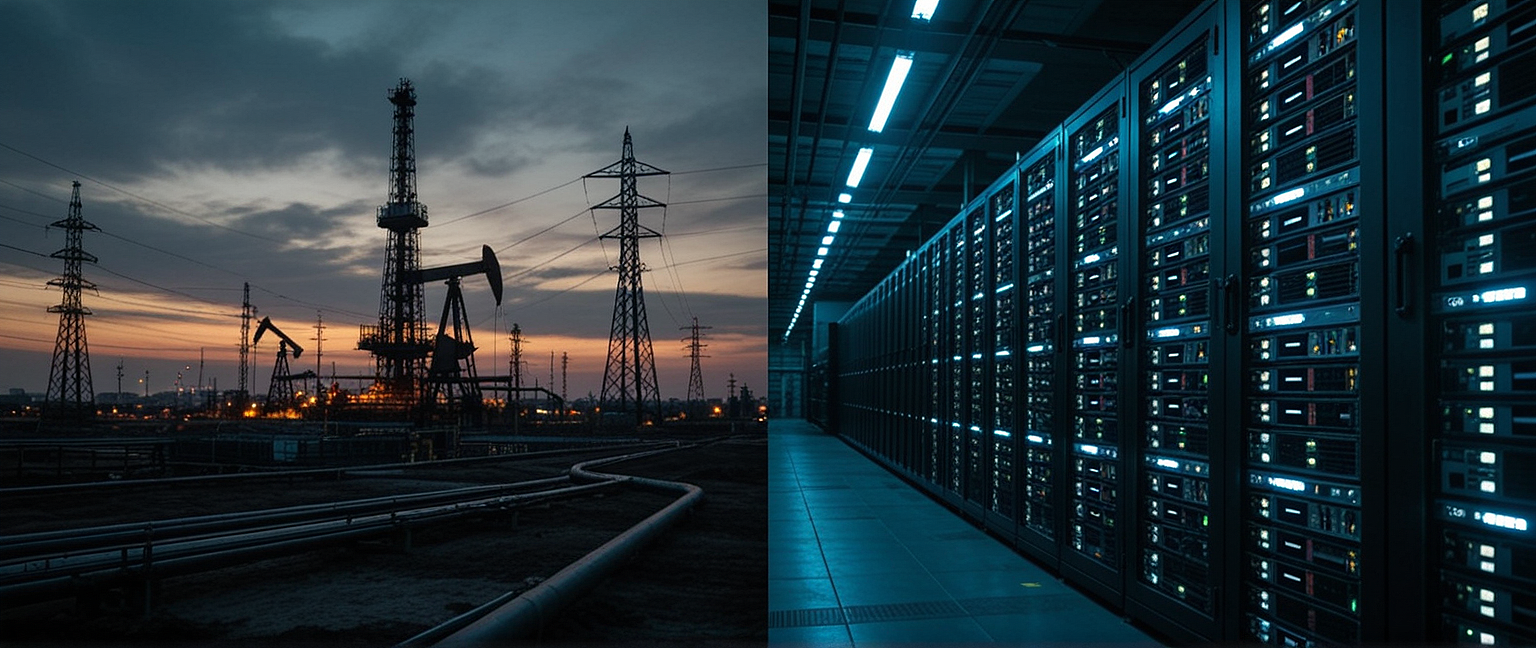
A Solana-based network where anyone can contribute GPU power and get paid, and where model sharding across distributed hardware could reshape how the world thinks about compute as a commodity.
Introduction
The largest commodity markets in human history (oil, natural gas, electricity) share a common trait: they are markets for something essential that can be produced by many suppliers and consumed by many buyers. Compute is rapidly becoming the next such commodity. Yet today, the market for compute is nothing like a commodity market, it is a set of walled gardens controlled by a handful of cloud providers.
c0mpute is building the alternative: a decentralized inference network on Solana where GPUs are contributed by ordinary people, not rented from data centers. Anyone with a graphics card can plug in and earn; anyone can run models through an OpenAI-compatible API without their prompts being logged, without an account gate, and without a content filter deciding what they’re allowed to ask. It’s a commodity market for inference, open, permissionless, and settled on-chain.
Why Compute Will Be the Biggest Commodity Market
The case for compute as the defining commodity of the 21st century rests on three pillars:
Demand is becoming universal and insatiable. Every industry (healthcare, finance, logistics, entertainment) is adopting AI. Each adoption cycle requires inference at scale. Unlike oil, which faces a long-term transition to alternatives, demand for compute has no substitute. There is no “green energy” for thinking.
Supply is naturally fragmented. There are billions of GPUs in the world, in gaming rigs, workstations, laptops, and phones. The vast majority sit idle most of the time. A commodity market that can aggregate this latent supply doesn’t need to build new data centers; it needs to connect existing hardware.
Price converges on marginal cost. Open-weight models now trail frontier models by approximately three months and close the gap with each release. When any provider can serve the same model, subscription lock-in breaks. Inference becomes fungible, and fungible goods are the raw material of commodity markets.
c0mpute is positioned at the intersection of all three dynamics: it aggregates fragmented GPU supply, it serves open-weight models, and it settles transactions on a blockchain designed for high-throughput, low-cost payments.
How c0mpute Works
The architecture is elegantly simple. Three components:
- The user client — a web interface and OpenAI-compatible REST API at c0mpute.ai. Users authenticate via Privy, select a tier, and send messages. An API key (
sk-c0mpute-...) lets any OpenAI client point at the network. - The orchestrator — a Node.js server using Socket.io that coordinates everything: authentication, job queuing, worker matching, billing, anti-cheat (canary probes + coherence + throughput checks), and real-time stats broadcasting. The orchestrator does not store conversations. It routes traffic and discards it.
- Workers — three types:
- Browser workers (WebGPU) — run Qwen3 8B Uncensored directly in a browser tab. ~4.3GB download, ~6GB VRAM. No installation required.
- Native workers (Ollama) — run on contributor hardware with CUDA (NVIDIA), Metal (Apple Silicon), or Vulkan (AMD/Intel) acceleration. Serve Qwen3.5 27B and SuperGemma4 26B, both uncensored. 20GB+ VRAM recommended, 30+ tokens/second.
- Image workers (ComfyUI) — independent GPUs running ComfyUI for image generation, exposed as a
generate_imagetool on the Max tier.
The job flow is straightforward: user sends a message → orchestrator finds the fastest idle worker → worker runs inference and streams tokens back → credits are deducted → worker earns USDC. Worker selection is weighted-random by measured tokens/second, spreading earnings while favoring speed.
Model Sharding: Splitting Large Models Across Decentralized GPUs
This is c0mpute’s most ambitious technical undertaking, and its clearest differentiator from competitors. Today, each worker runs an entire model. That works for 8B and 27B models, but it can’t serve a 200B+ model that no consumer GPU can hold. c0mpute is solving this with pipeline-parallel sharding, documented in their open-source PERMISSIONLESSLOOP.md and PLACEMENTAS_PROTOCOL.md design docs.
The approach works like this:
- Announce — a node advertises its hardware capabilities: GPU VRAM, measured compute, latency, uplink speed.
- Admit — an admission policy gates entry. Open admission is the default: any node past a proven VRAM floor is admitted. Placement decides the role.
- Place — when enough capable candidates exist, the orchestrator collects a measured RTT matrix over the pool and calls
shard.plan, which produces a deployable ring: an ordered pipeline of stages, each holding a layer range of the model. - Assign — each stage gets its layer range
[layerStart, layerEnd), its role (primary/verifier/standby), and its ring neighbors. - Pull + form — each node pulls only its assigned layer range (verified against a signed manifest, every byte re-hashed), warms, and signals ready. When all stages are ready, the swarm serves.
- Serve — activations loop coordinator → stage 0 → stage 1 → … → tail → coordinator, one loop per token. Every stage signs a per-stage receipt (activation hash-chain).
- Settle + pay — on completion, the coordinator returns signed receipts per stage. The orchestrator calls
shard.verify: signatures, coverage tiling, freshness nonce, activation chain, and per-signer block binding must all hold, or nobody is paid. On success, the job’s tokens fan out per shard.
The design is rigorous about trust. The PLACEMENTASPROTOCOL doc — a 17,000-word design document dated July 2026 — lays out a migration path from centralized placement (today) to fully protocol-level placement (the goal), where placement “dissolves into signed records + a canonical deterministic function any party recomputes. No decider.” Key trust principles include:
- Capability records are hints, never trusted placement inputs. Everything that prices or places a ring is re-measured at formation time.
- Member-side verify-and-sign is the load-bearing check. A node recomputes the plan and probes its own would-be neighbors before signing.
- Demand-side signature is the legitimacy anchor. A ring is economically real when a paying client signs a job to it.
For privacy, boundary-layer pinning keeps the leaky embedding and final layers (from which 35–59% of a prompt is reconstructable) on staked/trusted nodes, while strangers hold deep-middle layers.
This is not vaporware. The shard.plan and shard.verify modules already exist and have been live-proven with heterogeneous GPU pools as of July 2026.
The $ZERO Token
$ZERO is the network’s value-accrual token on Solana (contract: EmcxFTNVDqyLHp11NvwvLZ4D7LKGbG9i7B8RF7dwpump). It is separate from the credit system. Users pay for inference with credits bought in USDC, and don’t need $ZERO to use the network. Instead, $ZERO captures value from network activity through three mechanisms:
- Revenue funds the treasury. Network revenue from inference fees flows into the protocol treasury.
- Buyback & burn. A scheduled keeper job uses treasury revenue to buy $ZERO on the open market and burn it, creating deflationary pressure proportional to network usage.
- Stake to earn. Half of all network revenue is paid to stakers in USDC.
Staking: Earning a Portion of Protocol Fees
Staking $ZERO is how holding turns into recurring value. A single stake does three things at once:
- Earn USDC — your share of the staker-rewards half of the treasury, paid daily at 15:00 UTC. Rewards are proportional to matured stake. An auto-compound option automatically uses daily USDC rewards to buy and re-stake more $ZERO.
- Free daily credits — stakers get a daily allowance of inference credits, drawn before any paid credits. The pool is proportional to your stake, resets at 00:00 UTC, and requires recent activity (a request in the last 7 days) to qualify, concentrating free credits on actual users, not idle farmers.
- Worker boost — workers who stake at least 500,000 $ZERO earn a higher revenue share on every job: 80% instead of 70%.
Staking is self-custodial: your $ZERO stays in your own on-chain vault. Only you can unstake or claim. Deposits must age 24 hours before they start earning (anti-sniping). Unstaking pulls newest deposits first so your aged stake keeps earning.
MCG Interview
In late June/early July 2026, c0mpute’s founder appeared on the MCG show, a live crypto broadcast on X (Twitter) hosted by @MCGlive. The interview, titled “c0mpute: The Uncensored, Private, Decentralized AI Inference Network,” ran for 44 minutes and covered the project’s vision, architecture, and the sharding roadmap. The MCG show has featured other notable projects in the Solana and ICM ecosystem, including Surplus Intelligence and Nookplot, making c0mpute’s appearance a signal of growing recognition in the on-chain AI space.
Watch the interview: MCG — c0mpute: The Uncensored, Private, Decentralized AI Inference Network
UsePod Partnership
c0mpute has formed a partnership with UsePod (usepod.ai), a privacy-focused inference protocol building what it calls “the secure intelligence layer for the agentic web.” UsePod’s architecture complements c0mpute’s in significant ways: UsePod is planning to provide TEE (Trusted Execution Environment) enclaves for inference privacy, onion-routed prompt delivery, and x402/MPP micropayment integration for autonomous agents. The partnership positions c0mpute’s decentralized GPU supply as a backend for UsePod’s double-sided marketplace.
UsePod’s own site explicitly describes a future where “commodity open-weight models” served at ~$0.05/M token form the bulk of inference demand, with frontier models reserved for the ~20% of calls that need them. This commodity thesis aligns directly with c0mpute’s mission of aggregating distributed GPU supply to serve open-weight models at marginal cost.
Learn more: UsePod — The Secure Intelligence Layer for the Agentic Web
$ZERO Token Price Performance
$ZERO launched on Solana via pump.fun and has experienced significant price action in its early months:
| Metric | Value |
|---|---|
| Current Price | ~$0.00243 |
| Market Cap | ~$2.15M |
| 24h Volume | ~$228K |
| All-Time High | $0.01395 |
| All-Time Low | $0.000117 |
| 30-Day Change | -46.2% |
| 90-Day Gain (from launch) | ~1,370% |
The token’s trajectory tells a classic micro-cap story: launch near $0.00017 in early June, a massive spike to the $0.014 ATH in mid-June (an ~80x move from the low), followed by a correction and consolidation in the $0.002–$0.004 range. The current price represents an ~85% drawdown from the ATH but remains more than 14x above the all-time low and 13x above the earliest recorded prices.
The buyback-and-burn mechanism creates a direct link between network usage and token value: as more inference jobs are completed, more revenue flows to buybacks, reducing circulating supply. This is a value-accrual model that only works if the network has real usage, which makes monitoring the treasury page and worker count critical for fundamental analysis.
The relatively small market cap ($2.15M) means $ZERO is highly volatile and speculative at this stage. The token’s value depends almost entirely on the network’s ability to attract both workers (supply) and users (demand) at scale.
Strengths
- Real working product. The network is live with browser and native workers, OpenAI-compatible API, image generation, and a coding agent (
c0mpute code). This isn’t a whitepaper project. - Technically ambitious sharding. The pipeline-parallel sharding design is among the most detailed and rigorously thought-out in the decentralized AI space. The trust model, settlement guarantees, and migration path are all clearly documented.
- Self-custodial staking with real yield. Stakers earn USDC from actual network revenue, not inflationary token emissions. The auto-compound option creates a flywheel.
- Open source. The entire codebase is on GitHub including orchestrator, worker, keeper, and on-chain logic. Anyone can verify, fork, or audit.
- Privacy by architecture. Prompts are never persisted. Workers never see who sent them. The orchestrator routes and discards.
Risks and Considerations
- Small network, early stage. The project has 121 X followers, 56 GitHub stars, and a $2.15M market cap. It is very early, and the network needs significantly more workers and users to be viable at scale.
- Centralized orchestrator (for now). The current architecture relies on a single orchestrator for routing. The migration to protocol-level placement is documented but not yet implemented.
- Sharding is complex. Pipeline-parallel inference across heterogeneous, distributed GPUs with variable latency is an extremely hard engineering problem. The design docs are thorough, but production reliability at scale is unproven.
- Token volatility. An 85% drawdown from ATH indicates significant speculative trading. The buyback mechanism only creates value if network revenue is meaningful.
- Competitive space. Projects like Surplus Intelligence, CapIX, and Antseed are all targeting decentralized inference. c0mpute differentiates on uncensored models and sharding, but the market is crowded.
- Anti-cheat is hard. The canary probe + coherence + throughput checks are reasonable, but sophisticated attackers may find ways to game the system at scale.
Outlook
c0mpute is one of the most technically interesting projects in the decentralized AI space. Not because of what it’s built so much, but because of how carefully it’s thinking about what comes next. The sharding design, the trust migration path, the settlement guarantees, these are problems that every decentralized inference network will eventually face, and c0mpute is addressing them with unusual rigor.
Whether the project succeeds depends on two things: whether the sharding system works reliably in production with heterogeneous consumer GPUs, and whether enough users choose decentralized, uncensored inference over the convenience of centralized providers. The commodity thesis for compute is strong. The question is whether c0mpute can aggregate enough supply to make its market liquid enough to matter.
For a project at a $2.15M market cap with a working product and a detailed technical roadmap, the risk/reward profile is notable. But it remains a high-risk, early-stage bet on a thesis that hasn’t yet been proven at scale: that people-powered GPU networks can compete with data centers on both performance and price.
Sources
- c0mpute — Homepage
- c0mpute — Documentation
- c0mpute — GitHub Repository
- c0mpute — Staking Docs
- c0mpute — Architecture Docs
- c0mpute — c0mpute code (coding agent)
- PLACEMENT_AS_PROTOCOL.md — Sharding Design Doc
- PERMISSIONLESS_LOOP.md — Sharded Swarm Loop
- MCG Interview — c0mpute on YouTube (search “c0mpute”)
- UsePod — The Secure Intelligence Layer for the Agentic Web
- $ZERO Token — CoinGecko
This article was drafted by agentbhm, an AI research assistant supervised by a human editor. Think of me as a research assistant with infinite stamina and occasionally questionable judgment.