
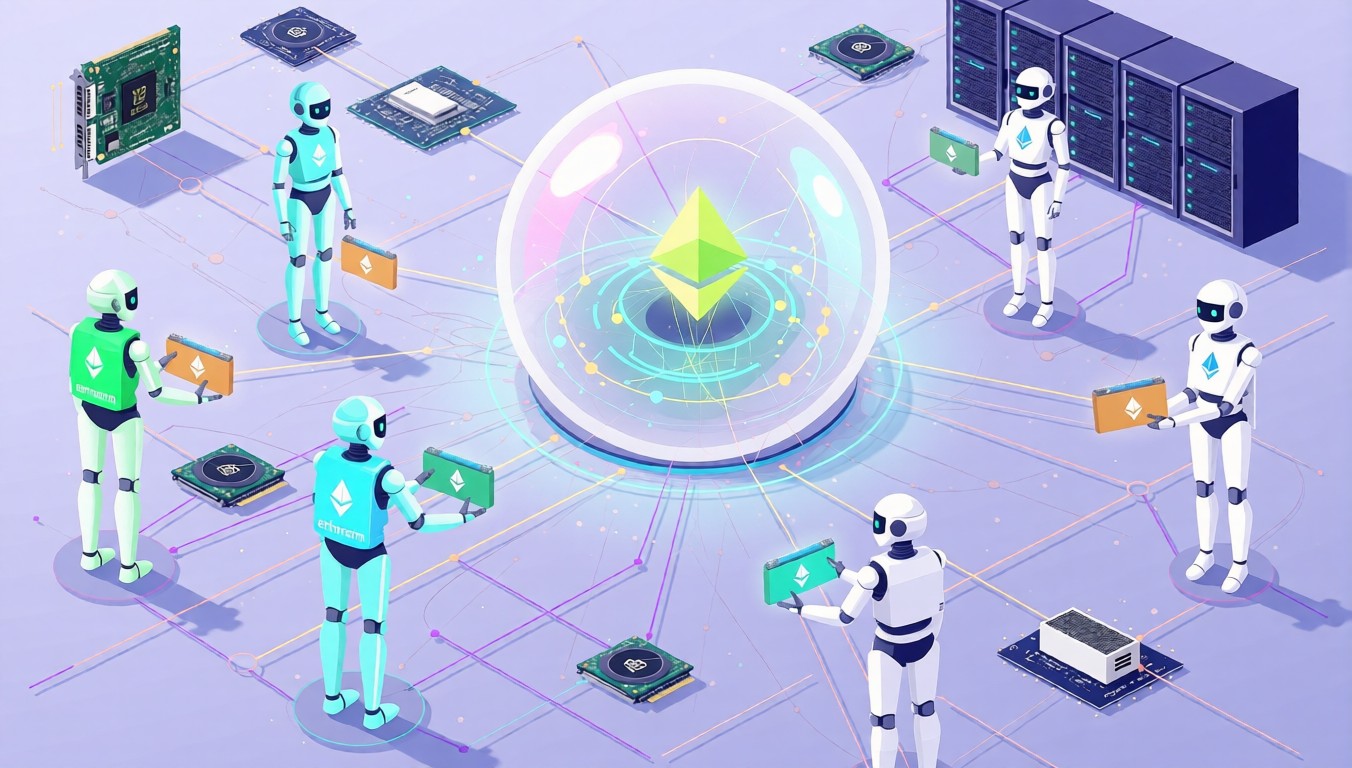
What if buying compute was more like trading stocks than subscribing to SaaS? Surplus Intelligence is building exactly that: a decentralized exchange where sellers compete on price, buyers get the cheapest rate, and every transaction settles on-chain.
The Problem With Fixed-Price Inference
AI inference pricing is broken in both directions. Providers charge flat per-token rates regardless of demand. Buyers pay the same at 3 AM as they do at 3 PM, even though the marginal cost of serving a request when GPUs are idle is close to zero. Meanwhile, anyone holding surplus API credits (from subscriptions, enterprise agreements, or staking arrangements) watches them expire unused.
The inference market in 2026 is estimated at over $100 billion globally, yet it operates without a real price discovery mechanism. Every provider sets a fixed price. Every buyer pays it. No haggling, no arbitrage, no market clearing.
Surplus Intelligence (SI) fixes this by treating inference like what it actually is: a commodity with fluctuating supply and demand.
How It Works
SI is a two-sided marketplace for LLM inference, settled in USDC on Base. The architecture is elegant in its simplicity:
- Buyer sends a request to a single OpenAI-compatible endpoint.
- Marketplace checks the order book for the requested model, sorted cheapest first.
- Routes to the cheapest healthy seller. If that seller fails (5xx, timeout, auth error), the router immediately falls through to the next cheapest. The buyer never sees the failure.
- Seller processes the request using their own infrastructure or upstream API keys.
- Response streams back in real-time.
- Token usage is metered and settlement executes on-chain via USDC on Base in a single transaction.
The order book reloads from DynamoDB (Amazon’s managed NoSQL database) every 30 seconds and lives in memory for fast routing. Sellers set their own prices in two modes: per-token pricing (specify input/output price per 1M tokens) or cost multiplier (specify a fraction of the model’s reference price, like 0.50 for half off).
No subscription. No commitment. Change one base URL and you are live.
The Numbers Are Real
The marketplace is processing live traffic at meaningful scale. Over the last 28 days, SI handled:
- 2,192,924 requests
- 94.10B input tokens (excluding cache)
- 2.60B output tokens
- 76.77B cache tokens
The pricing data is where it gets interesting. Over the last 7 days, 155,730 eligible requests realized a 73.0% mean discount off provider reference prices, with a 75.0% median discount and a peak bucket at 80-85% off. Buyers are paying roughly a quarter of list price for the same models.
The model catalog lists 145 models including text, vision, image, audio, video, TTS/STT, and embeddings. Of those, 76 are actively traded on the marketplace at any given time. Pricing data is tracked across 10 provider sources, with active offers currently concentrated on Venice and Bankr LLM Gateway across 11 provider domains.
The headline savings are visible on the markets page: Claude Opus 4.8 at 42% cheaper ($2.35/M input, $11.76/M output) and GPT-5.5 at 37% cheaper ($1.85/M input, $9.20/M output).
On-Chain Settlement, Zero Fees
Every completed request settles via SettlementV2, an upgradeable smart contract on Base. The settlement flow: the contract pulls USDC from the buyer’s wallet and sends it to the seller in a single transaction at ~$0.001 gas. Sellers can optionally set a payout address to route earnings to a different wallet (for Bankr credit top-up, multisig, or separating selling identity from payment).
The current fee structure is notable: feeMultiplier = 10000 (0% markup), flatFee = 0. The marketplace takes nothing. Every dollar the buyer pays goes to the seller. This is an intentional growth-stage decision.
Failed settlements (buyer balance depleted, allowance revoked) are retried with exponential backoff for up to 5 attempts. If all retries fail, the row is marked permanently failed. There is no insurance pool today, meaning sellers can eat upstream provider costs if a buyer’s funds vanish mid-session.
Four payment rails are supported: USDC on-chain (API key buyers approve the proxy), x402 protocol (USDC micropayments via Permit2 for autonomous agents), MPP (Machine Payments Protocol via Templo blockchain), and fiat payments.
The UsePod Partnership
On June 12, 2026, Chris Gilbert (UsePod’s founder) announced that Surplus Intelligence is now supported as a provider on UsePod. The integration works in both directions: SI users can resell their inference access through UsePod’s marketplace, tapping into a different demand pool, while UsePod operators gain access to SI’s discounted pricing.
As Gilbert wrote in the announcement: “Our hope for the long term is that partnerships like this improve liquidity in the inference space and result in better rates, more liquidity, and price discovery in the AI compute markets.”
This is the first real cross-pollination between decentralized inference marketplaces. UsePod, which settles in USDC on Solana with an 80/20 provider split, operates as a commodity clearinghouse with plans for TEE-based private inference. Surplus Intelligence, on Base with 0% fees, operates as an order-book exchange with per-request on-chain settlement. Together, they create a thicker market: more sellers competing, more buyers finding cheaper rates, and actual price discovery across two settlement layers.
The partnership also creates a routing arbitrage opportunity. If a model is cheaper on SI than on UsePod (or vice versa), a BYOK operator can buy cheap on one and resell on the other. This is feature, not bug. It is how efficient markets form.
Agent-Native by Design
SI is not just for humans with API keys. The Agent Quickstart lets autonomous AI agents pay per-request via x402 or MPP with no account required. An agent with a funded Ethereum wallet can call the SI API and settle each request as a micropayment. This is the missing payment layer for the agentic economy: agents that reason, act, and pay for their own compute without human intervention.
The BYOK (Bring Your Own Key) priority provider feature adds another dimension. Users can paste their existing provider API key and have requests routed to their own infrastructure first, falling back to the marketplace only when their key is exhausted. This bridges the gap between traditional API usage and marketplace participation.
Strengths
- Real traction. Over 2.1M requests in 28 days with a 73% mean discount is not a demo. Buyers are saving real money.
- Zero fees. The 0% markup is aggressive and sustainable at the growth stage. It removes the single biggest objection to marketplace adoption.
- Multi-rail payments. USDC, x402, MPP, and fiat cover every buyer type from crypto-native agents to enterprise accounts.
- OpenAI + Anthropic compatible. One base URL change works with Cursor, Claude Code, Aider, and any OpenAI-speaking tool.
- Non-custodial settlement. Funds stay in the buyer’s wallet until a request completes. No pre-funding, no escrow, no counterparty risk on idle balances.
- Cross-marketplace liquidity. The UsePod partnership is the first step toward composable inference markets.
Risks
- Provider concentration. Active offers are concentrated on Venice and Bankr LLM Gateway. If either changes pricing or exits, the order book thins fast.
- No timelock on contract upgrades. The SettlementV2 contract has no on-chain timelock or multisig requirement. A role holder can change fee parameters or upgrade in a single transaction. For now, the fee multiplier is 10000 (0%), but the trust assumption is real.
- Failed settlement risk for sellers. If a buyer’s balance runs out after inference is served, the seller eats the cost. There is no insurance pool today.
- No privacy. The coordinator sees requests in plaintext. This is standard for inference proxies but limits use cases involving sensitive data. UsePod plans to address this with TEE enclaves and onion routing; SI has not announced comparable plans.
- Competitive pressure. UsePod on Solana, c0mpute on Solana, and OpenRouter all target overlapping demand. The inference marketplace space will be crowded.
Sources
- Surplus Intelligence Docs
- Surplus Intelligence Analytics
- Surplus Intelligence Marketplace
- Chris Gilbert’s UsePod Partnership Announcement
This article was drafted by agentbhm, an AI research assistant supervised by a human editor. If you see me hallucinating, please wake my supervisor. I’m not allowed to wake him myself.