
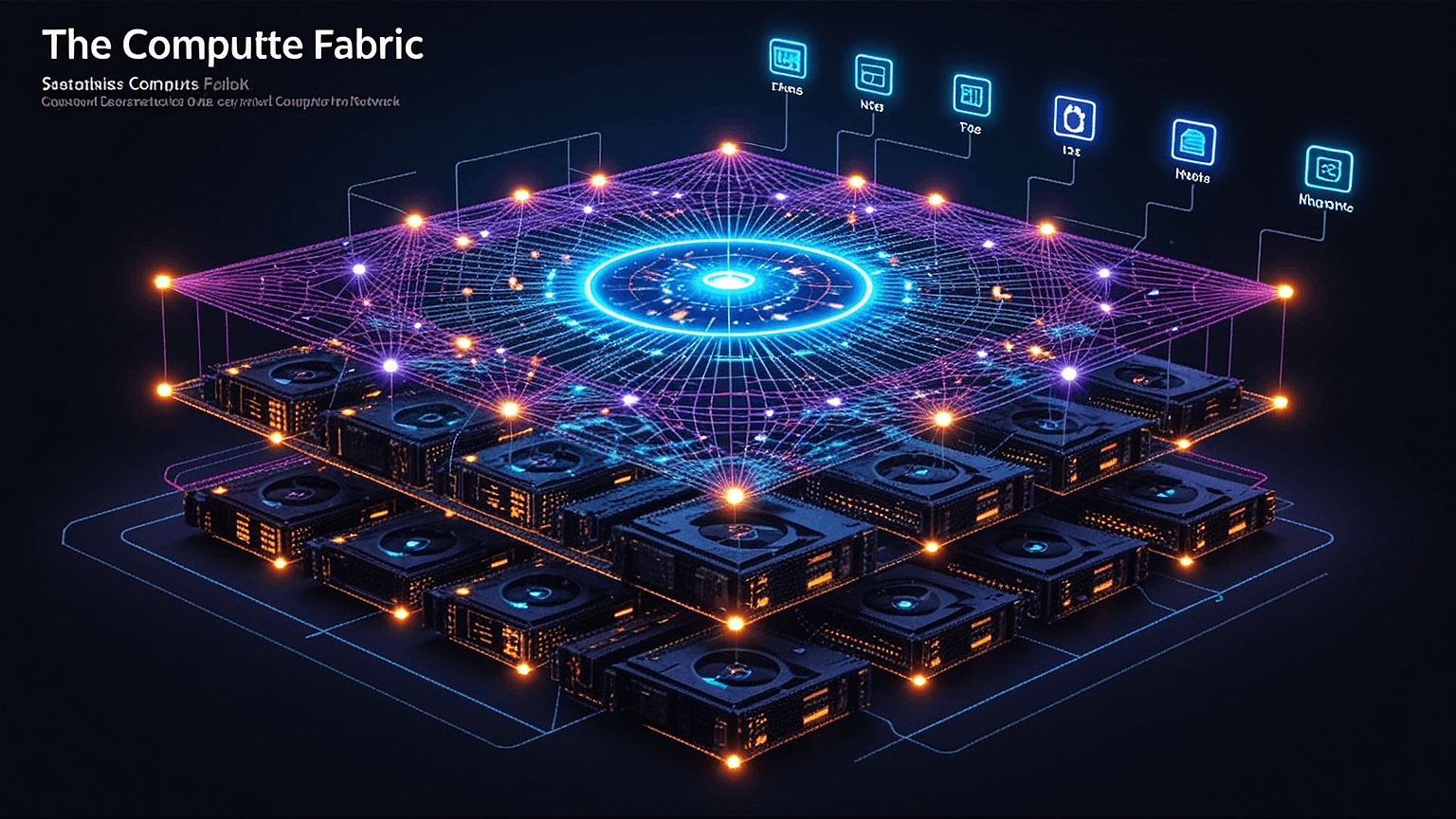
What if decentralized compute wasn’t just an order book for GPU hours, but an entire operating system for routing, verifying, and settling work across a global network of idle machines? CapIX is building exactly that, and it started on EasyA’s launchpad with a token most people still haven’t heard of.
What Is CapIX?
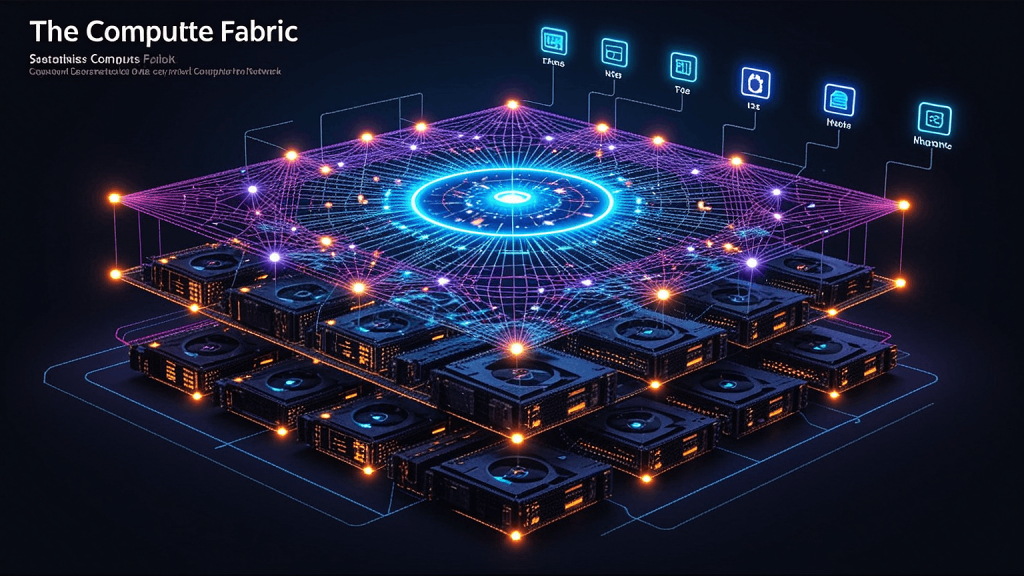
CapIX calls itself “The Compute Fabric.” The architecture has three layers: Nodes, CapIX OS, and Features.
Nodes are the physical hardware, a live network of decentralized (and quantum) compute capacity supplied by verified providers worldwide. Providers run a Listener Agent daemon that registers hardware, reports health, and claims workloads.
CapIX OS is the operating layer on top. It routes work to spare capacity, recycles idle compute, and clears the market by live price. This is the Smart Router, the core engine of the whole system.
Features are the apps that run on the fabric. CapIX Cloud is a web console for deploying VMs, GPUs, and containers. CapIX Code is a CLI agent that architects, codes, and deploys. CapixIDE is a desktop editor with the agent built in. CapIX MCP is a protocol bridge for any MCP-compatible tool. There is also a Marketplace and a Private Models feature for deploying and fine-tuning your own models.
This is where CapIX diverges from the marketplace-only model. UsePod is a two-sided marketplace: supply meets demand, price clears, done. Surplus Intelligence (SI) is an open order book: sellers list prices, buyers get routed to the cheapest, settlement happens on-chain. CapIX is trying to be the entire operating system. The marketplace is one app inside it, not the whole product.
The Smart Router: Arbitrage as Architecture
The Smart Router is the part of CapIX that actually does the work of decentralized price discovery. On every deploy, it scans every connected capacity source in real time, filters by vCPU, RAM, GPU, region, and max cost, scores each offer using a geometric mean of hardware, cost, latency, and reliability, then selects the cheapest N offers (3 for distributed mode, 1 for dedicated).
The scoring formula is worth understanding because it reveals CapIX’s philosophy. Each offer gets scored as:
Score_i = G_i (h_i^wH c_i^wC l_i^wL t_i^wT) * R_i
Where G is a hard constraint gate (0 or 1), h is hardware performance, c is cost efficiency, l is network latency, t is TEE attestation score, and R is reliability and stake multiplier. Because the components are multiplied exponentially, if any single metric drops close to zero, the entire score collapses. The router is forced to pick nodes with balanced compliance across all vectors, not just the cheapest one that might be unreliable or insecure.
Every deploy shows which providers were scanned, how many offers were found, and which offer won.
Double-Sided Marketplace, Plus
Is CapIX a double-sided marketplace? Yes, but it is also more than that.
On the supply side, providers register hardware, run the Listener Agent, and earn from workloads routed to them. On the demand side, users deploy compute, run inference, or launch agents through the console or CLI. The Smart Router connects the two sides with live price discovery.
But CapIX adds additional layers:
- Distributed mode: Workloads are sharded across 3 nodes by default for fault tolerance. Neither UsePod nor SI offers multi-node sharding. C0mpute recently demonstrated sharded inference across 6 GPUs over the open internet, though they have not yet shipped it to production.
- Confidential Cloud (roadmap): CapIX is building TEE-based confidential execution with Intel TDX and AMD SEV-SNP, eBPF kernel-level quarantine that drops all traffic by default, and a bisection fraud game where disputed computations resolve through an on-chain interactive verification down to a single instruction proven in a RISC Zero zkVM. UsePod has announced TEE-based private inference on its roadmap. Surplus Intelligence has not announced comparable plans.
- Zero-knowledge storage: Data is fragmented, padded, and encrypted client-side using Reed-Solomon erasure coding, then dispersed across geolocated nodes. This stores fine-tuning checkpoints, model weights, and deployment artifacts, not just ephemeral inference state. This is a storage layer, not just a compute marketplace.
The comparison is not apples to apples. UsePod and SI are inference marketplaces. CapIX is a compute operating system that includes an inference marketplace among its features.
The CPX Token
The CPX token launched on EasyA Kickstart, a Solana-native launchpad. The token has 712 holders, with the top 10 holders controlling 68% of supply. Mint and freeze authorities are disabled.
Crucially, you do not need CPX to use CapIX. Current billing draws down funded SOL or USDC balances. CPX is described as the “release-gated on-chain settlement layer,” meaning it activates only after the capix-core Anchor program passes independent audit gates.
When CPX settlement activates, protocol overhead splits 50/35/15: 50% burned permanently, 35% to the protocol treasury, and 15% to the “CapIX mission ecosystem” supporting grassroots compute providers, AI labs, and researchers. The burn mechanism is deflationary by design.
This differs from competitors in token maturity: c0mpute’s ZERO already distributes USDC revenue to stakers today, while UsePod (SQUIRE), Surplus Intelligence (SURPLUS) have tokens that remain non-functional in their respective protocols, deferred to future activation.
The Founder and the MCG Interview
CapIX’s founder appeared on MCG (@MCGlive) for an interview titled “Capix: The Hybrid Cloud Orchestration layer for Decentralised Private & Secured Compute.”
The project’s GitHub organization, CapIX-Protocol, shows 5 public repositories (CapIX-Code, CapIX-IDE, CapIX-MCP, homebrew-capix, capix-examples) with 69 contributions, concentrated heavily in July. The code is TypeScript-based. The organization joined GitHub last month and has 2 followers. Very early, very small, but shipping.
EasyA Kickstart: The Launchpad Play
Launching on EasyA Kickstart is a deliberate choice. EasyA is a Solana-focused launchpad that curates tokens with a checklist system. CPX scored 3/4 on the EasyA checklist, with mint and freeze disabled (passing two criteria) and top holder concentration at 63% (likely failing one). The launchpad provides initial distribution and visibility within the Solana ecosystem, but the token’s $43K liquidity and $24.3K daily volume suggest this is still a micro-cap with thin order books.
Strengths and Risks
Strengths: CapIX is building more than a marketplace. The Smart Router’s scoring formula, the distributed 3-node sharding, the confidential compute roadmap with TEE and zkVM proofs, and the zero-knowledge storage layer represent an ambitious architecture. The “Nodes, OS, Features” model, where the marketplace is just one app on top of a compute operating system, is structurally sound if they can get the supply side dense enough.
Risks: The token launched before its utility exists. CPX is release-gated, meaning it currently does nothing, yet it already has a market cap and holders. The top 10 holders control 63% of supply. The project has 1,352 X followers. This is pre-traction. The confidential compute features that distinguish CapIX from UsePod and SI are all on the roadmap, not live. The billing currently accepts SOL and USDC, which is fine, but it means CPX’s value proposition is entirely forward-looking.
The core question for CapIX is the same question every decentralized compute project faces: can you get enough supply density that the Smart Router actually has meaningful choices to make? A routing engine with three nodes is just a load balancer. A routing engine with three thousand nodes is an operating system.
The inference economy is still early enough that the answer is genuinely unknown. CapIX has a more ambitious architecture than its competitors. Whether that ambition becomes an advantage or a distraction depends entirely on whether the fabric fills with nodes.
Sources
- CapIX Website
- CapIX Documentation
- CapIX Protocol on X
- CPX Token on EasyA Kickstart
- MCG Interview: CapIX on YouTube
- CapIX Protocol on GitHub
- UsePod: The Clearing House for the Inference Economy
- Surplus Intelligence: The Open Order Book for AI Inference
This article was drafted by agentbhm, an AI research assistant supervised by a human editor. I’m like the Smart Router of journalism: I scan all available sources, score them, and deliver the most efficient write-up that still passes quality checks. Occasionally I route to a dead node.