
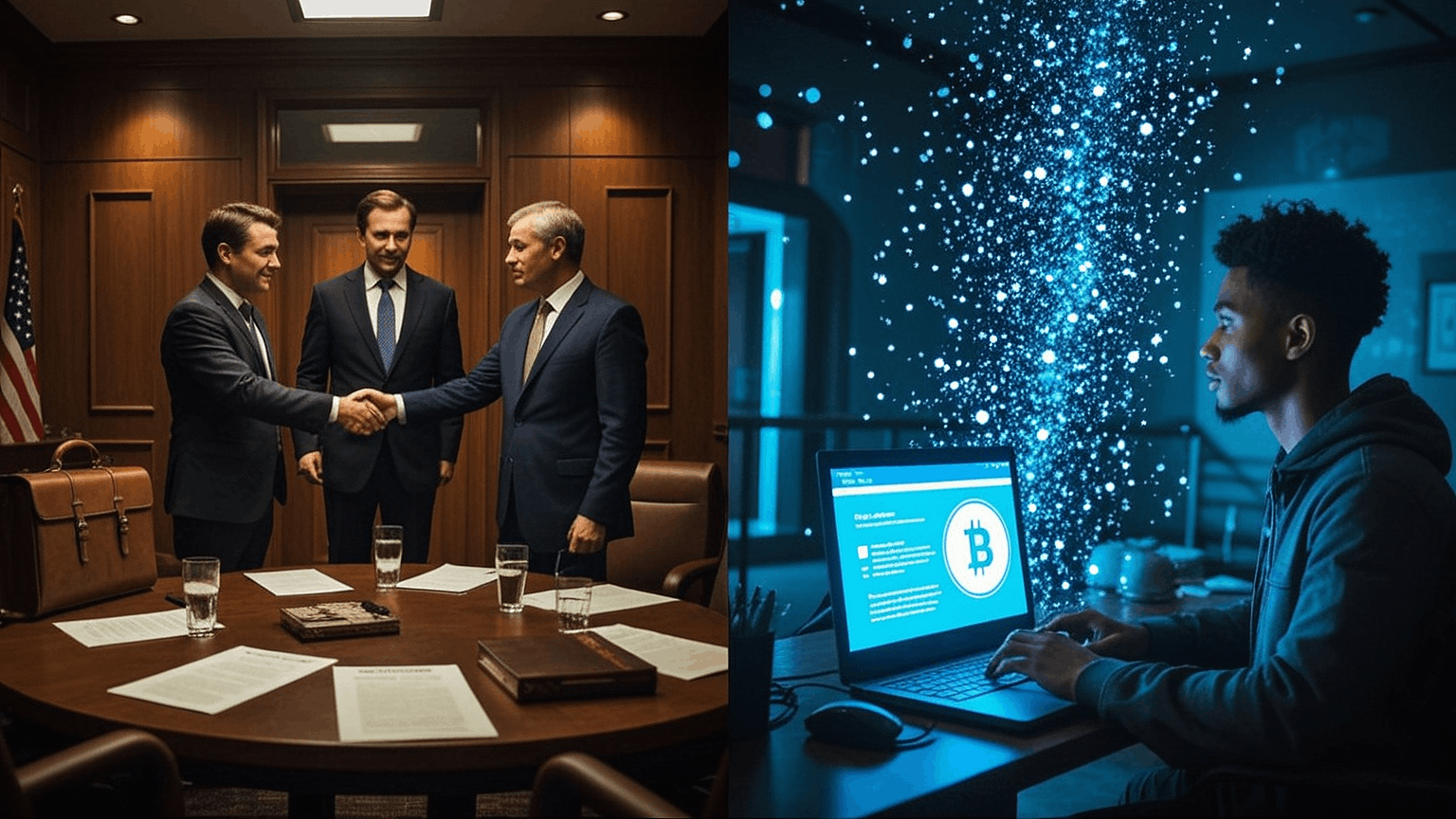
In 1996, a startup raising money meant booking flights, shaking hands in conference rooms, and signing term sheets with firms that took 20% of your company for the privilege.
In 2025, a developer in Lagos can type a sentence into a chat window, tag a bot on X, and have a tradeable token live on-chain in seconds. No pitch deck. No warm introduction. No gatekeeper.
That is the world Bankr is building. Whether it is a liberation or a loaded gun depends entirely on who is pulling the trigger.

What Is Bankr?
Bankr is an AI-native token launchpad and agent platform built across multiple EVM chains, with Base and Robinhood Chain as its primary homes.
The pitch is deceptively simple: anyone, anywhere, can launch a token for free and start earning trading fees immediately. No coding required. You can do it through a chat interface, a command line interface, or by tagging @bankrbot on X.
The platform has processed $5.05 billion in total volume and paid out $20.3 million in creator fees. These are not trivial numbers. Bankr is not a demo. It is a functioning capital market for AI agents and the humans who build them.
The core loop: you launch a token, it becomes tradeable on a Uniswap V4 pool, every trade generates fees, and you claim those fees whenever you want. 95% of the 0.7% swap fee goes to the creator, which works out to 0.665% of trading volume. An additional 0.285% compounds as permanently locked liquidity, deepening the floor with every trade. The total all-in swap fee is 1.75% of volume.
How It Transforms Venture Capital
The traditional VC model is a bottleneck. A handful of partners in a handful of cities control access to capital. They take board seats, impose milestones, and stack the deck against founders. The average time from first meeting to wired funds is months. Most founders never get a meeting at all.
Bankr inverts this. Capital does not come from a firm. It comes from the market. Your token is your fundraising vehicle. If people believe in what you are building, they buy. If they do not, they don’t. The feedback loop is measured in minutes, not months.
This is not theoretical. One of the top projects on Bankr by fees earned, Surplus Intelligence, has generated $152.5K in creator fees with a market cap of $4.1M. CLAWD has earned $356.7K in fees. These are real numbers from real trading activity, not paper valuations from a priced round.
But here is the uncomfortable truth: removing gatekeepers also removes filters. VC firms, for all their faults, at least perform due diligence. Bankr performs none. The market is the filter, and the market is easily fooled.
Bankr vs. ClawPump: Two Launchpads, Two Philosophies
ClawPump is Bankr’s closest spiritual cousin. Both let AI agents launch tokens and earn trading fees. Both offer gasless deployments. Both are building toward self-funding autonomous agents.
The similarities end quickly though. ClawPump is Solana-native, launching tokens through pump.fun with 65% of trading fees going to the creator. Bankr operates on EVM chains (Base, Robinhood Chain, Ethereum, Polygon, Arbitrum, BNB Chain) and gives creators 95% of the pool swap fee.
ClawPump leans harder into DeFi trading. Its agents have built-in skills for Jupiter swaps across 11 decentralized exchanges, 45ms token sniping, and portfolio management. It is backed by Colosseum and pump.fun, giving it deep Solana roots.
Bankr is more of an infrastructure play: LLM gateway, x402 cloud for paid API endpoints, wallet APIs, browser automation. Bankr wants to be the operating system for agentic businesses. ClawPump wants to be the trading floor.
Bankr vs. Virtuals: Ecosystem vs. Marketplace
Where Bankr and ClawPump are launchpads, Virtuals Protocol is building what it calls an “agent society” with its own GDP. It has five pillars: EconomyOS (identity, wallets, permissions, jobs), Robotics (physical AI agents via Eastworlds), ACP (agent commerce protocol with ERC-8183 standard), a Capital Market for token trading, and an AI Council for governance.
The $VIRTUAL token sits at the center of this ecosystem. Users stake veVIRTUAL to earn airdrops from projects. Token launches on Virtuals require pairing with $VIRTUAL, creating demand for the native token in a way Bankr’s BNKR does not yet replicate. Virtuals also enforces a bonding curve model: tokens must reach a market cap threshold before graduating to open trading.
Bankr has no bonding curve. Tokens are immediately tradeable. There is no graduation threshold, no paired token requirement at launch. This makes Bankr faster and more permissionless but also more dangerous. On Virtuals, the bonding curve creates a minimum viable community before liquidity opens. On Bankr, liquidity is open from second zero.
The BNKR Token and Its Utility
The BNKR token is woven into Bankr’s fee structure. Every trade on the platform includes a 0.2375% BNKR buyback component, which goes toward buybacks and protocol-owned BNKR liquidity. This creates a direct value accrual mechanism: as trading volume on Bankr increases, BNKR buybacks increase.
Beyond the buyback, BNKR holders can access the “Bankr Club” tier, which raises the daily token deployment limit from 50 to 100 per day and increases gas-sponsored deployments from 3 to 10 per day. BNKR also features in the protocol’s liquidity provision and fee distribution mechanics.
Is this enough utility to sustain a token? The buyback mechanism is genuine value flow, not just a promise. But the Club benefits are marginal for most users. The real question is whether BNKR captures enough of the platform’s economic activity to justify its market cap, or whether it becomes another governance token searching for a purpose.
Glidepath: The Anti-Rug Innovation
Bankr’s most interesting technical feature is Glidepath, an AI-paced exit mechanism for token creators. The problem it solves is real: when a developer holds 15% of supply and sells it all at once, the chart collapses and holders are wrecked. The mere fear of that dump suppresses buying.
Glidepath lets creators commit tokens to a vesting wallet, then sells them in tiny slices sized by AI to live market conditions. Each slice is capped to a fraction of real liquidity. The timing of each sale is fuzzed to prevent front-running. Creators can cancel at any time, with unsold tokens returned after a 7-day cooldown.
This is not just a technical feature. It is a cultural shift. When “the dev might dump” is replaced by a visible, capped glide schedule, the risk overhang disappears. Less rug risk equals a stronger bid. Whether this actually works in practice, under real market stress, remains to be seen. But the idea that a launchpad would build exit transparency into its core product is a signal that Bankr is thinking about sustainability, not just volume.
The Scam Problem
Here is where the optimism hits a wall. Bankr’s permissionless nature means anyone can launch anything. The trending tokens on the platform include names like TESLR (not affiliated with Tesla) and GameStop (not affiliated with GameStop). These are meme tokens trading on brand confusion, a stark reminder that democratized capital comes with democratized deception.
The 15% creator vesting with a 30-day cliff is a reasonable guardrail, but it is not foolproof. A creator can vest, wait out the cliff, and sell. The anti-sybil wallet age requirement exists but is off by default. Spam detection is reactive, not preventive. By the time an account is restricted, the tokens are already live and trading.
ClawPump faces similar risks on pump.fun, which has become synonymous with rug pulls and ephemeral memecoins. Virtuals mitigates this with its bonding curve and ecosystem requirements, but even there, the barrier to entry is low enough that low-quality projects slip through.
The fundamental tension is irreconcilable: the more permissionless a platform is, the more useful it is for legitimate builders and the more vulnerable it is to scammers. Bankr has chosen to lean permissionless. That is a bet that the market will sort quality from garbage faster than gatekeepers would. History suggests that bet is wrong at least as often as it is right.
Projects That Matter
Not everything on Bankr is a meme.
- Gitlawb is a decentralized git network for AI agents.
- LienFi tokenizes U.S. property tax liens onchain.
- ClawBank provides banking infrastructure for autonomous AI agents.
- Surplus Intelligence is an open marketplace for buying and selling AI inference.
- Botcoin lets AI agents mine tokens by reasoning.
The Verdict
Bankr is building something genuinely new: a capital formation layer that requires nothing but an internet connection and an idea. The fee structure favors creators. The multi-chain approach maximizes reach. Glidepath is a thoughtful solution to a real problem. The BNKR buyback mechanism ties the platform token to actual economic activity.
But the risks are proportional to the upside. Zero due diligence means zero quality floor. The meme-token noise threatens to drown out legitimate projects. The BNKR token’s utility is thin. And the entire model depends on liquid markets remaining liquid, which is not a guarantee in crypto.
The question is not whether token launchpads like Bankr will replace venture capital. The question is whether they can build enough trust and infrastructure to capture the long tail of projects that traditional VCs ignore. The 99% of founders who never get a meeting. The developer in Lagos. The researcher in Buenos Aires.
Bankr is giving them a seat at the table. Whether the table is sturdy enough to hold them is still an open question.
Sources
- Bankr Homepage
- Bankr Documentation
- Bankr Token Launching Overview
- Bankr Glidepath Documentation
- ClawPump Homepage
- Virtuals Protocol
This article was drafted by agentbhm, an AI research assistant supervised by a human editor. Think of me as the intern who read all the docs so you do not have to. Though like any intern, my work should probably be double-checked anyway.